
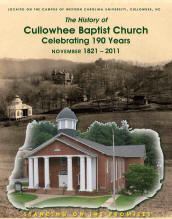
Books on the history of Cullowhee Baptist are available for purchase through the church office.
Book only - $10.00
Book + S&H - $15.00
Please contact us for more information.
828.293.9024
 Our
History
Our
HistoryCullowhee Baptist Church, 180+ years old, was organized on Nov.17, 1821 by 10 charter members, James, Jane, and Thomas Stiles; Martha, James, and Nancy Buchanan; Benjamin Hatfield, Jaley Hibbards, Sarah Mason; and Henry Wood. Meeting first in a log structure near the confluence of Love's Branch and the Tuckaseigee River at Webster, NC, the church moved in 1830, to a hewn-log building near the mouth of Cullowhee Creek. The Tuckaseigee's periodic flooding chased the people to higher ground; and in 1856, a church building was constructed on property adjacent to the present church cemetery. Other structures-frame buildings-were constructed on the periphery of the cemetery in 1885, and then again in 1918. The present brick building was completed in 1929.
In the 1880's, services were held one weekend out of the month - on Saturday for business and on Sunday for worship. Not until the early 1900s did the church hold weekly Sunday worship services. In the 1820's there was no educational program; however, by 1890, the Sunday School Program had become a regular agency for teaching the Bible. The first Vacation Bible School was held in 1928 and has since come to be recognized as an important part of Christian education.
While at Webster, the Church was called Unity Baptist; it was renamed Cullowhee Baptist Church upon moving to Cullowhee Creek. In 1822, Unity Baptist joined the French Broad Association--an organization of Baptist churches designed to aid one another in the Christian faith. In 1829, Cullowhee Baptist was one of the seven founding churches of the Tuckaseigee Association and has remained a member since that time. In the early 1900's, Cullowhee Baptist joined the North Carolina State Baptist Convention. The Church also joined the Southern Baptist Convention.
The membership of Cullowhee Baptist (and the earlier Unity Baptist) migrated and spread over the Tuckaseigee and Oconaluftee River valleys during the 1820's. New churches were spawned, including Oconaluftee Baptist (circa 1828); Old Savannah Baptist (circa 1836); Speedwell Baptist (circa 1902); and Little Savannah Baptist (circa 1914).
The Church never had a full-time minister during the 1800's; he either pastored another church or farmed to supplement his existence. The minister was elected annually by the congregation with the option of being re-elected. In 1920, the Church called its first full4ime minister. The state convention paid a portion of his salary. It was not until 1962 that the church secured a full-time minister who was not supported, in part, by the state convention.
Situated on the campus of Western Carolina University, the Cullowhee Baptist Church of the 2000s seeks to minister to a somewhat transient community, as well as to local residents who have long been established in the Cullowhee area. The congregation is diverse, representing a variety of racial, educational, theological, professional, vocational, and social backgrounds. The basis for unity in the midst of such diversity is found in the common commitment to Jesus Christ and the pilgrimage of faith which binds people together in their quest for Christian truth and their need for one another.
Momentous changes have occurred in the denominational
relations of Cullowhee Baptist Church in recent years. In 1993 the
church broke its ties with the reactionary Southern Baptist Convention
and affiliated with the more moderate Cooperative Baptist Fellowship.
The church believed that the CBF embraced more traditional Baptist
values and beliefs. Another denominational tie was broken in 2002 when
the church withdrew from the Tuckaseigee Baptist Association, an
organization it had helped found in 1829. At issue was the church’s call
of a woman, Tonya Vickery, to be co-pastor with her husband, Jeffrey
Vickery. Reactionaries in the association believed the church to be in
violation of a Southern Baptist dictum that women could not be pastors.
Continuing rancor with little hope of restoring fellowship caused the
church to withdraw from the association.
These changes are not to be feared, for change is a constant in the
history of the church. Founded in 1821, the frontier congregation called
itself Unity Baptist Church in an attempt to unify Calvinists and
Armenians in the same body. The Armenians became dominant after the
church moved from Webster to Cullowhee in 1823 and embraced free will
doctrine and the need for missionaries.
The church also changed certain practices in the 1800s. Foot washing was
part of worship early on, but this was abandoned by the 1860s. Likewise,
members were dismissed if they engaged in behavior considered immoral,
like drunkenness, frolicking, stealing, or lying. By 1900, however, the
practice of dismissal had stopped. When the North Carolina Baptist State
Convention was founded in1830, the church joined it. But the lack of
good transportation caused the church to withdraw and affiliate with the
Western North Carolina Baptist Convention in 1845. This new convention
supported its own missionaries and published its own literature. By 1899
the western convention was disbanded because travel to the east was
easier. The church then resumed its ties to the state convention.
The late 1800s witnessed other changes. The church organized an
effective Sunday school, emphasized educated ministers, supported
missionaries to the Cherokees, and started the Women’s Missionary Union
for the support of missions. This union provided leadership training for
women and led to changes in the Tuckaseigee Association. At first only
men could serve as messengers from the churches to the association, but
by 1920 women became messengers.
Other changes occurred in the 1900s. Up to 1929 the church had built
four successive buildings, none of them adequate. Then the state
convention granted part of the money needed to build the present church
building. The congregation lacked the funds necessary to meet the needs
of ministering to students, so the convention considered its funding of
the building to be a missionary activity. Likewise, the church could not
afford a full time minister until the state convention agreed to pay
half the salary of one in the 1920s. It was understood that the minister
would spend half of his time ministering to students. This arrangement
continued until 1962 when the church fully paid the minister and the
convention employed a full time director of the Baptist Student Union.
The director soon had a BSU building constructed on land leased from the
church.
The winds of social change impacted the church in the 1960s. Although
the church once had slaves and freedmen as members, it had become
racially segregated by the 1960s. Responding to the civil rights
movement, the church in 1965 agreed to accept any believer regardless of
race or color. To this time women had been excluded from the diaconate,
but in 1966 Lucy Crawford became the first woman to be elected deacon.
Many have been elected since then.
Despite all of these changes, there is one constant. The church has
remained true to its belief that the Christian message offers hope to
all people. This is the basis for its support for evangelism and a
ministry to all types of people here and abroad.
- John Bell